

When the kidneys can no longer remove enough waste and extra fluid from the body, dialysis may be needed. Two common options are peritoneal dialysis and hemodialysis. Both help manage kidney failure but they work in different ways and can affect daily life differently.
Understanding Peritoneal Dialysis vs Hemodialysis can help patients and families prepare for treatment decisions. One method uses a machine to filter blood outside the body, while the other uses the lining of the abdomen as a natural filter. Treatment schedules, access methods, home requirements and possible complications also differ.
There is no single dialysis method that is best for everyone. The right choice depends on medical needs, lifestyle, home environment, personal preferences and the guidance of a nephrologist.
For a closer look at home-based treatment, explore our guide to home hemodialysis in El Paso.
Quick Insight: Peritoneal Dialysis vs Hemodialysis
Peritoneal dialysis uses the lining of the abdomen to filter waste and extra fluid from the blood, usually at home. Hemodialysis uses a machine and dialyzer to clean blood, often at a dialysis center. Neither method is universally better; the most suitable option depends on the patient’s health, treatment needs and lifestyle.
What Is Hemodialysis?
Hemodialysis is a treatment that removes waste, extra fluid and certain minerals from the blood using a dialysis machine. It is commonly performed at a dialysis center, although some patients may receive home hemodialysis after training.
How Does Hemodialysis Work?
During hemodialysis, blood flows from the body through a dialyzer, also called an artificial kidney. The dialyzer filters waste and extra fluid before the cleaned blood returns to the body.
Hemodialysis usually requires vascular access.
Common access types include:
- AV fistula: A connection between an artery and a vein.
- AV graft: A synthetic tube that connects an artery and a vein.
- Dialysis catheter: A tube placed in a large vein, often used when other access is not ready or suitable.
Types of Hemodialysis
In-center hemodialysis: Performed at a dialysis facility with trained staff. Patients typically receive treatment three times a week for about four hours per session.
Home hemodialysis: Performed at home after training. It offers a flexible schedule, including shorter, more frequent or overnight treatments, as prescribed.
Reference: NIDDK – Hemodialysis
What Is Peritoneal Dialysis?
Peritoneal dialysis is a treatment that uses the peritoneum, the natural lining inside the abdomen, to filter waste and extra fluid from the blood. A soft catheter is placed in the abdomen to allow dialysis solution to flow in and out.
How Does Peritoneal Dialysis Work?
During peritoneal dialysis, dialysis solution enters the abdominal cavity through the catheter. Waste and extra fluid move from the blood vessels in the peritoneum into the solution. After a prescribed period, the used fluid is drained and replaced.
This process is called an exchange. Patients receive training to perform exchanges safely and prevent infection.
Reference: NIDDK – Peritoneal Dialysis
Types of Peritoneal Dialysis
There are two main forms of peritoneal dialysis:
- Continuous Ambulatory Peritoneal Dialysis (CAPD): Patients perform manual fluid exchanges during the day.
- Automated Peritoneal Dialysis (APD): A machine called a cycler performs exchanges, often while the patient sleeps.
Key Insight: Both peritoneal dialysis and hemodialysis require consistent treatment and strict hygiene. Proper catheter care and following your care team’s instructions help reduce the risk of infection and other complications.
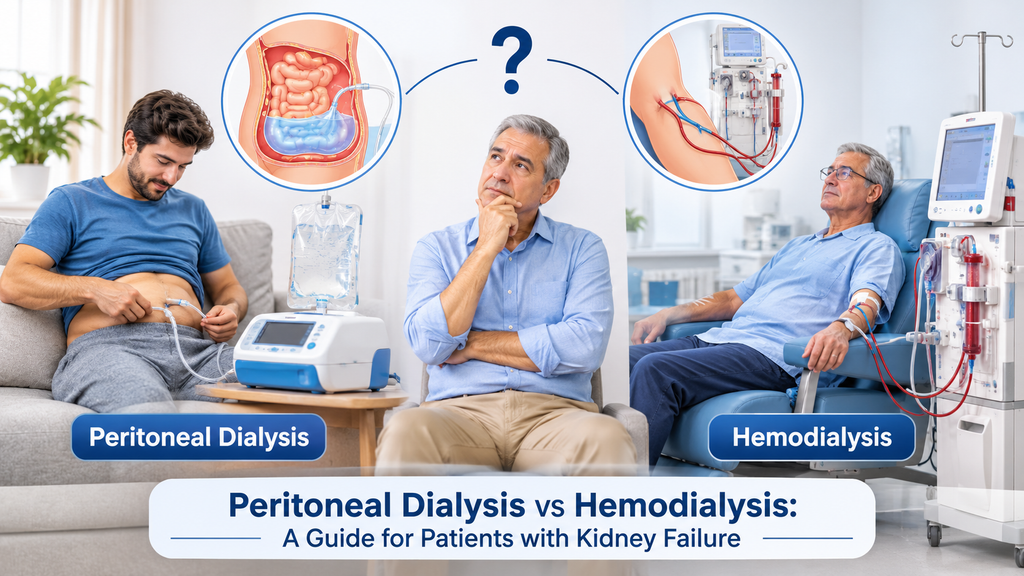
Peritoneal Dialysis vs Hemodialysis: Key Differences
The main difference in hemodialysis vs peritoneal dialysis is how blood is filtered. Hemodialysis uses an external machine, while peritoneal dialysis uses the abdominal lining.
| Comparison Factor | Hemodialysis | Peritoneal Dialysis |
|---|---|---|
| How it works | Blood passes through a dialyzer | Abdominal lining filters blood |
| Access | Vascular access | Abdominal catheter |
| Common location | Dialysis center or home | Usually home |
| Schedule | Often several sessions weekly | Daily exchanges or overnight treatment |
| Patient role | Center staff may manage most tasks | Patient manages exchanges after training |
| Main infection concern | Vascular access infection | Peritonitis |
| Home supplies | Required for home hemodialysis | Dialysis solution and supplies need storage |
| Flexibility | Depends on treatment schedule | May fit more easily around daily activities |
The comparison between peritoneal dialysis and hemodialysis is not only about the procedure. It also includes the time required, the level of independence and the type of support available.
Peritoneal Dialysis vs Hemodialysis Pros Cons
Both treatments can help manage kidney failure. Their advantages and limitations differ, so patients should discuss how each method may fit their health and routine.
Benefits and Drawbacks of Hemodialysis
Hemodialysis may be suitable for patients who prefer treatment managed by a medical team.
Benefits:
- Trained staff are available during in-center treatment.
- Patients may not need to manage dialysis equipment themselves.
- Treatment takes place on a set schedule.
Drawbacks:
- Center visits may require travel and planning.
- Treatment can take several hours per session.
- Some patients experience fatigue or blood pressure changes.
Benefits and Drawbacks of Peritoneal Dialysis
Peritoneal dialysis may appeal to patients who want to manage treatment at home.
Benefits:
- Treatment can usually be performed at home.
- Scheduling may offer greater flexibility.
- It does not require blood to pass through an external dialyzer.
Drawbacks:
- Exchanges or overnight treatment are needed every day.
- Supplies require storage space.
- Infection, including peritonitis, is a potential complication.
- Patients must follow strict hygiene and catheter-care steps.
Key Insight: The choice between hemodialysis and peritoneal dialysis depends on a patient’s medical needs, daily routine and personal preferences. Each option has its own benefits and limitations, so a nephrologist can help determine the most suitable approach.
Which is more better, hemodialysis or peritoneal dialysis?
Neither hemodialysis nor peritoneal dialysis is automatically better for every patient. The right choice depends on medical needs, daily responsibilities, personal preferences and the ability to follow the treatment plan.
Patients who prefer professional supervision may feel more comfortable with in-center hemodialysis. Those who want to manage treatment at home and can follow proper hygiene steps may prefer peritoneal dialysis.
A nephrologist considers kidney function, other health conditions, access requirements and the home environment before recommending a treatment. Patients may also be able to switch methods if their health or circumstances change.
Reference: National Kidney Foundation – Choosing Dialysis: Which Type Is Right for Me?
When to Use Peritoneal Dialysis vs Hemodialysis
- Peritoneal dialysis: May suit patients who prefer home treatment and flexible scheduling.
- Hemodialysis: May suit patients who prefer supervised treatment at a dialysis center.
- Medical needs: Kidney health, other conditions and access requirements influence the choice.
- Lifestyle: Daily routine, home support and personal preference also matter.
A nephrologist can help determine the most suitable treatment for each patient.
Which Is More Costly, Hemodialysis or Peritoneal Dialysis? Cost of Hemodialysis vs Peritoneal Dialysis
The cost of hemodialysis vs peritoneal dialysis varies by location, provider, insurance coverage, treatment frequency and supplies. A simple comparison of session charges may not reflect the full cost of care.
Costs may include:
- Hemodialysis: Treatment sessions, transportation, medicines and related medical care.
- Peritoneal dialysis: Dialysis solution, catheter supplies, training, equipment when required and ongoing monitoring.
- Home treatment: Storage, utility needs and possible home adjustments.
The peritoneal dialysis vs hemodialysis cost comparison depends on individual treatment needs and coverage. Patients should request a detailed estimate from their provider and confirm what their insurance plan covers.

Explore Kidney Care Options at The Kidney MD
Choosing between peritoneal dialysis and hemodialysis can feel overwhelming but you do not have to make the decision alone. At The Kidney MD, patients can receive dialysis treatment and care in El Paso, guidance to better understand their treatment options, potential benefits and possible risks.
Take the next step toward informed kidney care with The Kidney MD.
Contact Information
The Kidney MD
Address: East Location, 11163 La Quinta Pl, Suite A200, El Paso, TX 79936
North East Location, 9101 Dyer St #102, El Paso, TX 79924
Call: 915-218-6055
Email: contactus@thekidneymd.com
Final Thoughts
Understanding Peritoneal Dialysis vs Hemodialysis helps patients compare how each treatment works, what it requires and how it may affect daily life. Both options can manage kidney failure but their schedules, access methods, risks and responsibilities differ.
The right treatment plan should reflect the patient’s health, preferences and support needs. The Kidney MD provides kidney care and guidance to help patients discuss treatment options with a nephrologist. Speak with a kidney specialist to learn which dialysis approach may be appropriate for your individual needs.
FAQs – Peritoneal Dialysis vs Hemodialysis: A Guide for Patients with Kidney Failure
Q1. Does hemodialysis always take place in a dialysis center?
Ans. No. Hemodialysis can be performed in a dialysis center or at home. Home hemodialysis requires training, suitable equipment and a treatment plan developed with the care team.
Q2. What is the difference between peritoneal dialysis and hemodialysis nursing?
Ans. In hemodialysis, nurses monitor treatment, vital signs and vascular access. In peritoneal dialysis, nursing care focuses on catheter care, exchange technique, hygiene and preventing infections.
Q3. What are the risks of peritoneal dialysis vs hemodialysis?
Ans. Peritoneal dialysis may cause catheter infections or peritonitis. Hemodialysis may involve vascular access infections, low blood pressure or muscle cramps. Risks vary by patient and treatment plan.
Q4. Does peritoneal dialysis require daily treatment?
Ans. Yes. Peritoneal dialysis typically involves daily exchanges or overnight treatment using a cycler. The schedule depends on the prescribed plan and the patient’s needs.
Q5. Can patients switch from hemodialysis to peritoneal dialysis?
Ans. Some patients can switch between hemodialysis and peritoneal dialysis when medically appropriate. The decision depends on health status, access options and treatment suitability. Patients should consult their nephrologist before making changes.