

“Understanding your kidney health starts with testing.”
Your kidneys work around the clock to filter waste from your blood, remove extra fluid and maintain a healthy balance of minerals. A kidney function test can help assess how well they are working. It may also reveal early changes, even when you feel fine and have no noticeable symptoms.
High creatinine, a low GFR or protein in your urine may raise questions about your kidney health. These results do not always mean you have kidney disease but they deserve attention. A kidney blood test can help your doctor evaluate kidney function, especially if you have diabetes, high blood pressure or a family history of kidney problems.
Explore the full range of kidney care services in El Paso at The Kidney MD for expert, personalized nephrology care.
Quick Insight: What Does a Kidney Function Test Show?
A kidney function test shows how well your kidneys filter waste and maintain fluid and mineral balance. Blood tests measure creatinine and estimate GFR, while urine tests detect albumin, helping identify possible kidney damage or changes in kidney function.
What Is a Kidney Function Test?
Kidney function tests help assess how well your kidneys are working and whether they show signs of damage.
A kidney function test, also called a renal function test, is a group of laboratory tests that evaluate how effectively your kidneys filter waste from the blood, regulate blood pressure and maintain fluid and electrolyte balance.
A kidney health test may be recommended during a routine checkup or if you have risk factors such as:
- Diabetes
- High blood pressure
- Heart disease
- A family history of kidney disease
These tests provide useful information about kidney health, helping your doctor determine whether further testing or evaluation may be needed.
What are the Main Tests for Kidney Function?
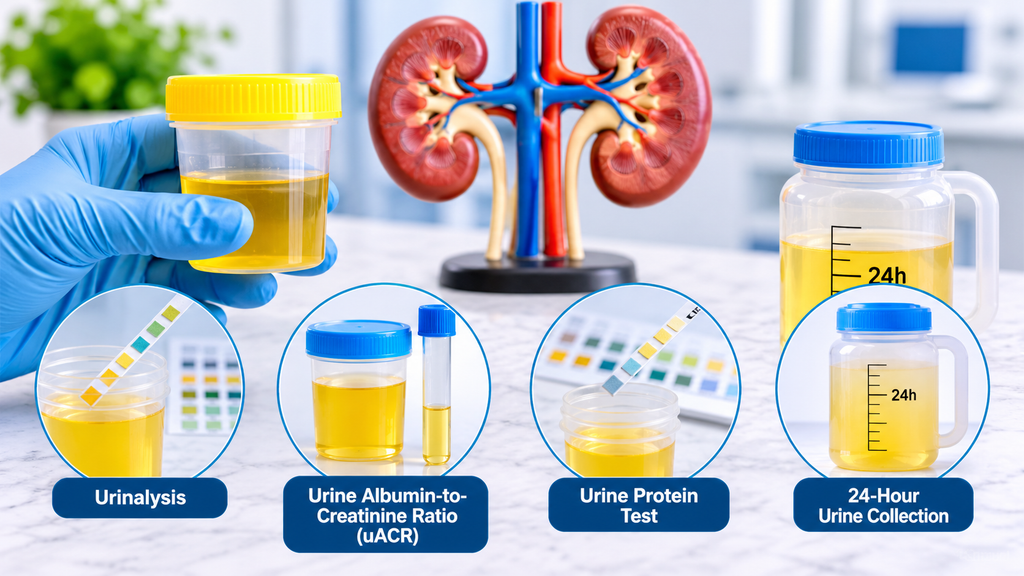
Common kidney function test names include serum creatinine, estimated GFR (eGFR), blood urea nitrogen (BUN), electrolyte tests, urinalysis, urine albumin-to-creatinine ratio (uACR) and 24-hour urine protein testing.
Blood and urine tests help assess kidney health by measuring waste products, estimating filtration and detecting kidney damage. A kidney function test may be recommended based on your symptoms, risk factors and medical history. NIDDK explains kidney disease testing.
The following is a kidney function test list, including the main blood and urine tests used to assess kidney health.
Blood Tests for Kidney Function
Blood tests help assess how well the kidneys remove waste and maintain the body’s chemical balance.
1. Serum Creatinine Test
The serum creatinine test measures creatinine, a waste product released during normal muscle activity. Healthy kidneys filter it from the blood and remove it through urine.
# Why it matters: High creatinine may indicate reduced kidney filtration. Muscle mass, medications and other factors can also affect the result.
# Normal Results: A normal serum creatinine result is:
- Men: 0.7–1.3 mg/dL (62–115 µmol/L)
- Women: 0.5–0.95 mg/dL (44–84 µmol/L)
# Key Insight: Creatinine levels can vary based on factors such as muscle mass, age and laboratory reference ranges. Creatinine is also used to calculate the estimated glomerular filtration rate (eGFR), which helps assess how efficiently the kidneys filter blood.
Reference: MedlinePlus – Creatinine Test
2. Estimated Glomerular Filtration Rate (eGFR)
The estimated glomerular filtration rate (eGFR) estimates how much blood the kidneys filter each minute. It is usually calculated using blood creatinine and factors such as age and gender. Cystatin C may also be used when appropriate.
# Why it matters: A lower eGFR may indicate reduced kidney filtration.
# Common adult categories:
| eGFR (mL/min/1.73 m²) | Category |
|---|---|
| 90 or higher | G1 – Normal or high |
| 60–89 | G2 – Mildly decreased |
| 45–59 | G3a – Mildly to moderately decreased |
| 30–44 | G3b – Moderately to severely decreased |
| 15–29 | G4 – Severely decreased |
| Below 15 | G5 – Kidney failure range |
# Key Insight: G1 and G2 do not establish chronic kidney disease (CKD) on their own. Evidence of kidney damage or other diagnostic criteria must also be present.
Learn more about eGFR categories and CKD classification.
3. Blood Urea Nitrogen (BUN) Test
The blood urea nitrogen (BUN) test measures nitrogen from urea, a waste product formed when the body breaks down protein. The kidneys remove urea through urine.
# Why it matters: BUN may rise when kidney function decreases. Dehydration, diet and other conditions can also affect the result.
# Typical adult range: Approximately 6–20 mg/dL, depending on the laboratory.
# Key Insight: BUN is interpreted alongside creatinine and eGFR rather than used alone.
4. Electrolyte Tests
Electrolytes are minerals that help regulate fluid balance, nerve signals and muscle function. The kidneys help maintain their levels within a healthy range.
| Electrolyte | Common adult reference range |
|---|---|
| Sodium | 135–145 mEq/L (135–145 mmol/L) |
| Potassium | 3.7–5.2 mEq/L (3.70–5.20 mmol/L) |
| Chloride | 96–106 mEq/L (96–106 mmol/L) |
| CO₂ (carbon dioxide) | 23–29 mEq/L (23–29 mmol/L) |
# Note: Reference ranges vary by laboratory. MedlinePlus explains common blood chemistry tests.
# Why they matter: Abnormal levels may occur when the kidneys cannot regulate minerals or acid-base balance effectively. Other conditions can also cause changes.
5. Cystatin C Test
The cystatin C test measures a protein filtered by the kidneys. It can be used to estimate GFR.
# Why it matters: It may help clarify kidney filtration when creatinine-based eGFR is less reliable, such as in people with unusual muscle mass.
# How results are used: Cystatin C is generally used to calculate eGFR. The appropriate reference range depends on the laboratory and testing method.
The NIDDK laboratory evaluation of kidney disease discusses the use of filtration markers in kidney assessment.

Urine Tests for Kidney Function
Urine tests can detect substances that may indicate damage to the kidneys’ filtering units. They complement blood tests by identifying signs of kidney damage.
1. Urinalysis
A urinalysis examines urine for blood, protein, glucose and other findings.
# Why it matters: Blood or protein in urine may indicate kidney damage or another urinary tract condition.
# Expected result: Typically negative for significant blood and protein, although interpretation depends on the test and laboratory.
# Key Insight: An abnormal result may require further testing to identify the cause. MedlinePlus explains urinalysis and kidney testing.
2. Urine Albumin-to-Creatinine Ratio (uACR)
The urine albumin-to-creatinine ratio (uACR) measures albumin, a blood protein, relative to creatinine in a urine sample. It is commonly used to detect early kidney damage.
# Why it matters: Damaged kidney filters may allow albumin to pass into urine.
# Common adult categories:
| uACR (mg/g) | Category |
|---|---|
| Below 30 | A1 – Normal to mildly increased |
| 30–300 | A2 – Moderately increased |
| Above 300 | A3 – Severely increased |
# Key Insight: A uACR of 30 mg/g or higher may indicate kidney damage. Doctors may repeat the test because temporary factors, such as strenuous exercise or infection, can affect the result. Read more about albuminuria categories and CKD classification.
3. Urine Protein Test
A urine protein test checks whether excess protein is passing into the urine.
# Why it matters: Protein leakage may indicate damage to the kidney’s filtering units.
# Expected result: Usually negative or within the laboratory’s stated reference range.
# Key Insight: The test may use a dipstick, a protein measurement or a protein-to-creatinine ratio. MedlinePlus describes common kidney function tests.
4. 24-Hour Urine Collection
This test measures substances in urine collected over a full 24-hour period. It may be recommended when a more detailed measurement is needed.
# Why it matters: It can measure daily protein excretion or other substances relevant to kidney assessment.
# Typical total urine protein: Your doctor will interpret the 24-hour urine protein result using the laboratory’s reference range.
# Key Insight: A 24-hour collection is not required for everyone. A spot uACR is commonly used for routine assessment of urine albumin.
Reference: NIDDK – Assess Urine Albumin
Other Tests Used to Assess Kidney Health
Additional tests may be recommended when blood and urine results do not explain a problem or when a structural concern is suspected.
Kidney ultrasound
Uses sound waves to examine kidney size, shape and possible blockages.
CT scan
Provides detailed images that may help identify kidney stones, blockages or structural abnormalities.
Kidney biopsy
Removes a small tissue sample for examination. It may help identify the cause or type of kidney damage.
These tests do not have a single numerical reference range. Their findings are interpreted based on the clinical situation.
Choosing the Right Kidney Function Tests: Not everyone needs all these tests. Your doctor will recommend the appropriate blood tests, urine tests or imaging based on your symptoms, medical history and kidney health.

How Are Kidney Function Test Results Interpreted?
Doctors interpret kidney function test results together rather than relying on a single number. They consider eGFR, urine albumin, medical history and other findings to understand how well your kidneys are working.
Key Points:
- Low eGFR: May indicate reduced kidney filtration.
- Increased urine albumin: May suggest damage to the kidney’s filtering units.
- Persistent abnormalities: Findings lasting at least three months may indicate chronic kidney disease (CKD).
- Repeat testing: May be needed to confirm whether an abnormal result is persistent.
An eGFR below 60 mL/min/1.73 m² or a uACR of 30 mg/g or higher, when persistent for at least three months, may indicate CKD. These findings can also be indicators of poor kidney function and require medical evaluation.
Your doctor will recommend appropriate monitoring or further testing based on your medical history, risk factors and overall kidney health.
Reference: National Kidney Foundation – How to Classify CKD
Important Note: Reference ranges may vary between laboratories. Test results should be interpreted by a qualified healthcare professional. This article is for educational purposes only and does not replace professional medical advice, diagnosis or treatment.
What Can Abnormal Kidney Function Test Results Mean?
Abnormal kidney function test results do not always indicate chronic kidney disease. Their meaning depends on which test is abnormal and whether the change is temporary or persistent.
- High creatinine: May indicate reduced kidney filtration or be influenced by muscle mass, exercise and certain medicines.
- Low eGFR: May suggest reduced kidney filtering ability.
- Albumin in urine: May indicate damage to the kidney’s filtering units.
- Electrolyte changes: May suggest problems with fluid and chemical balance.
Your doctor may recommend repeat testing or further evaluation to identify the cause of abnormal results.
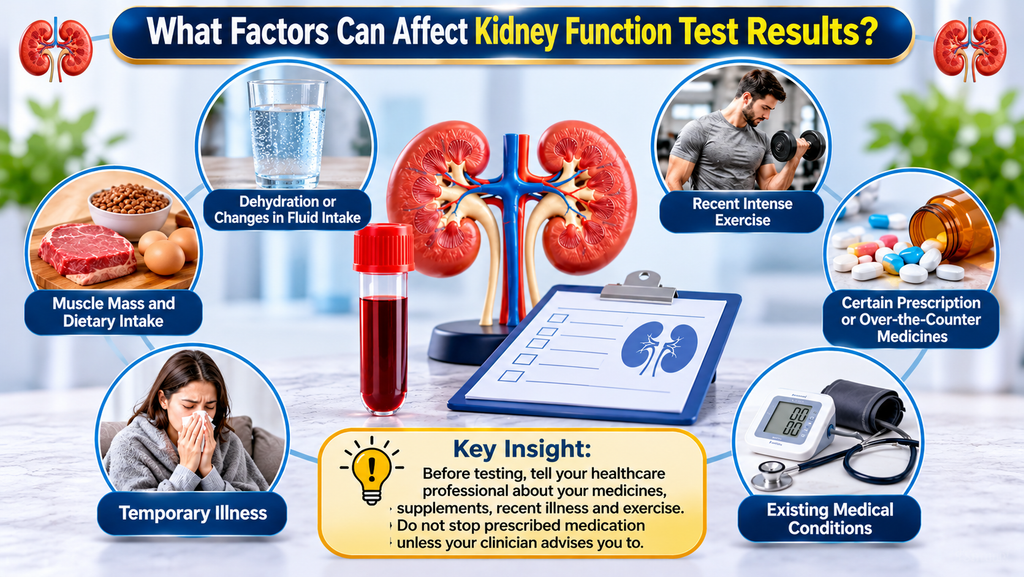
What Factors Can Affect Kidney Function Test Results?
Several factors can influence a kidney function test report, including:
- Dehydration or changes in fluid intake
- Recent intense exercise
- Muscle mass and dietary intake
- Certain prescription or over-the-counter medicines
- Temporary illness
- Existing medical conditions
Key Insight: Before testing, tell your healthcare professional about your medicines, supplements, recent illness and exercise. Do not stop prescribed medication unless your clinician advises you to.
Need Expert Kidney Care in El Paso, TX?
Concerned about your kidney function test results or experiencing changes in kidney health? The Kidney MD provides specialized kidney care to help evaluate abnormal results, identify potential concerns and guide your treatment.
Schedule your kidney function tests at The Kidney MD with an experienced kidney specialist in El Paso. Get expert guidance to understand your test results, discuss your kidney health and receive personalized recommendations for the next steps toward better kidney health.
Contact Information
The Kidney MD
Address: East Location, 11163 La Quinta Pl, Suite A200, El Paso, TX 79936
North East Location, 9101 Dyer St #102, El Paso, TX 79924
Call: 915-218-6055
Email: contactus@thekidneymd.com
Final Thoughts
A kidney function test can help you understand how well your kidneys filter waste and maintain the body’s balance. Creatinine, eGFR and urine albumin are important measurements but their meaning depends on your overall health and whether results change over time.
If you have questions about your kidney function test report or need help understanding abnormal results, speak with a qualified healthcare professional. People in El Paso and nearby areas can explore kidney care options with The Kidney MD and discuss an appropriate plan for their kidney health.
“Take the first step toward healthier kidneys with timely testing and expert care you can trust.”
FAQs – Kidney Function Test: What Your Results Reveal
Q1. What is the normal range for a kidney test?
Ans. The kidney function test normal range depends on the specific test and laboratory. An eGFR of 90 or higher is generally considered normal or high, while creatinine reference ranges vary by individual factors and lab.
Q2. How much does a kidney function test cost?
Ans. The kidney function test price varies by laboratory, location and which tests are included. Contact a local testing provider or your healthcare professional for current pricing and coverage details.
Q3. Can I take a kidney function test at home?
Ans. Some at-home urine tests can check for certain markers but they do not replace a complete clinical assessment. Ask a healthcare professional which kidney function test is appropriate for your situation.
Q4. What is the most accurate test for kidney function?
Ans. eGFR is widely used to estimate kidney filtration. In some cases, a clinician may use cystatin C or a measured GFR test when a more precise assessment is needed.
Q5. What Is a normal GFR for age?
Ans. Normal GFR generally decreases with age as kidney function changes over time. However, age alone does not determine whether kidney function is healthy. Doctors interpret eGFR alongside urine albumin levels, medical history and other test results.